Skipping the primer doesn’t speed up the work — it only postpones the problem. Applying topcoat paint without a primer causes a range of issues: uneven absorption, patchy coverage, stain bleed-through, and premature wear. The primer prevents these problems — and its cost is significantly lower than that of the topcoat paint.
Primer paint is not a covering layer — it bonds the substrate and the topcoat paint, creating the conditions for an even application. Its functions can be divided into four main groups:
Absorption-regulating primer: on highly absorbent substrates (porous plaster, aerated concrete, fresh gypsum), it ensures even absorption. Without primer, the topcoat paint dries into the absorbent areas and loses coverage, while forming a surface layer on less absorbent parts — resulting in patchiness.
Adhesion-enhancing primer: on smooth, non-absorbent surfaces (old paint layers, polished concrete, gypsum), it improves the adhesion of the topcoat paint. Where the surface "has no grip," the primer provides micro-roughness and a chemically bonding surface.
Stain-blocking primer: on surfaces stained with nicotine, soot, coal tar, or water marks, it prevents bleed-through. This special pigment-containing primer locks in the stain and allows the topcoat paint to cover evenly.
Breathable primer: for breathable wall systems where silicate or lime paint is applied, a compatible mineral primer ensures that the primer does not seal the wall.
The function determines the material — this is the most common source of error in primer selection: absorption-regulating primers do not block stains, and stain-blocking primers do not necessarily improve adhesion on smooth surfaces. Always decide based on the specific problem and substrate type.
Important: chemical compatibility between primer and topcoat paint is required. Use a silicate-compatible primer under silicate topcoat paint — a dispersion primer prevents chemical bonding and negates the benefits of silicate paint.
Primer should be applied with a roller or brush, followed by the topcoat paint after the drying time has elapsed. Do not shorten the drying time: the primer’s function occurs during drying, and applying the topcoat paint too soon suppresses the primer’s effect.
After applying primer, the surface may look different from the dry substrate — this is not a defect but a sign of absorption regulation.
Browse our primer paints or request advice to select the right primer for your topcoat paint and substrate type.
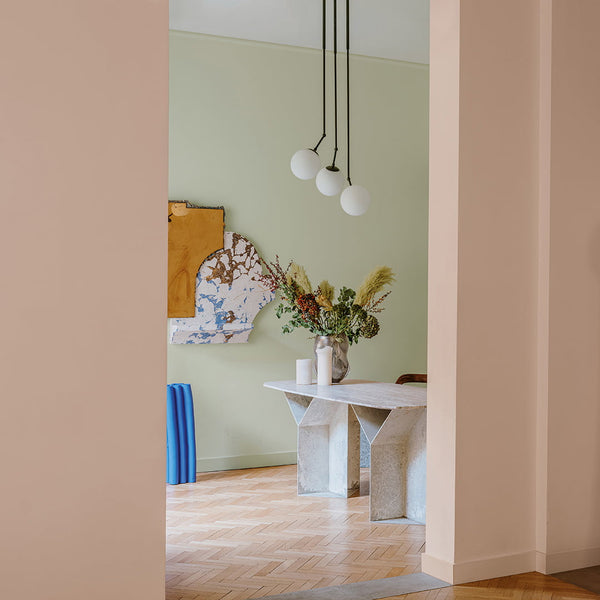
The Kerakoll Color Collection is an integrated project that includes innovative materials - resin, cement, handcrafted wood, microcoatings, paints, and glazes - coordinated on a single color palette.