

Geocalce or Biocalce? The three Geocalce plasters and their lime-based equivalents
If you’re renovating an old solid-walled house or heritage building, sooner or later the question arises: Geocalce or Biocalce? Both are Kerakoll’s cement-free, natural hydraulic lime (NHL) based plasters. Both breathe and both suit old masonry. So the question isn’t which is “better,” but what each is optimized for.
In this article, we review the three Geocalce plasters — Intonaco, Multiuso, and Tenace — looking at their Biocalce equivalents and when to choose each.
The common base: lime, not cement
Before diving into the differences, it’s worth clarifying why either is valuable. Old stone and brick walls are vapor-permeable. If you apply cement plaster, the cement traps vapor: the wall stays damp, rising moisture and salts accumulate behind the plaster, which then bulges and detaches.

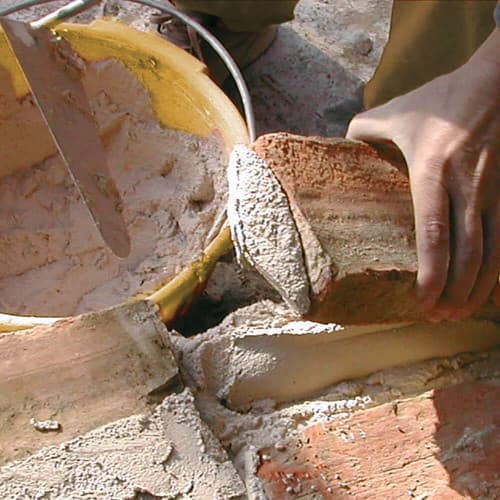
Natural hydraulic lime (NHL) and mineral additives.
Lime plaster is the opposite. NHL lime plaster lets vapor escape and, due to its low modulus of elasticity, moves with the wall without cracking. Both Geocalce and Biocalce have this property. So on an old wall, either is better than cement — from here, the choice is about fine-tuning.
And breathability is just the headline. The same lime chemistry makes the wall salt-resistant (in the Anstett test, lime–pozzolan expands less than 0.8%, while cement expands about 40%), inhibits mold growth (drier, alkaline surface, verified by ISO 846), makes the material soft and reversible (can be removed from old brick or stone without damage, hence accepted by heritage conservation authorities), and provides a low ecological footprint (fired at lower temperatures than cement and absorbs CO₂ from the air during setting). We cover all this in detail in our article Lime plaster: what it’s for and when to choose it.

Lime (µ ≈ 6) allows much more vapor to pass through than cement (µ ≈ 20). Source: Biocalce brochure.
The main difference: geo-binder versus pure lime
Here is what most comparisons misunderstand. Both families are built on the same NHL 3.5 natural hydraulic lime. The only distinguishing ingredient is:
- Geocalce — NHL 3.5 lime plus mineral geo-binder. The geo-binder gives Geocalce its grayish shade, making it the foundation of Kerakoll’s structural and earthquake-resistant systems, and allowing the product line to achieve higher strength (up to CS IV for plasters, and M5–M15 for Antisismico structural mortars). It is also generally more economical.
- Biocalce — the same NHL 3.5 lime, but pure, without geo-binder. This purity gives its plaster the best vapor permeability (lower µ-value), as well as the white/natural, top-quality heritage character.

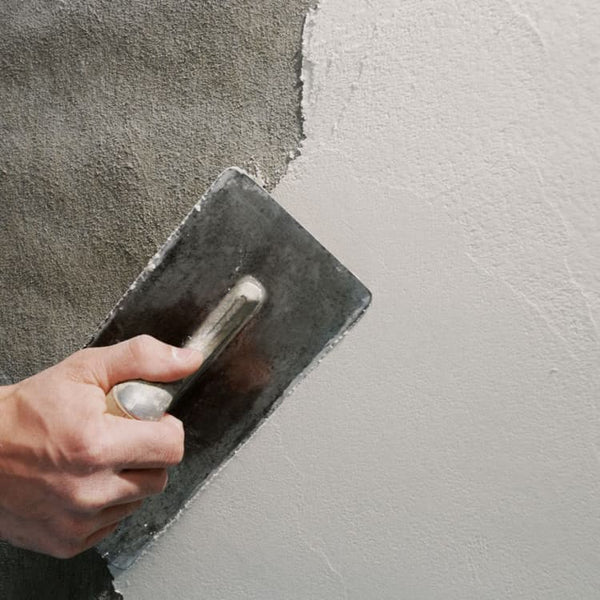
The same NHL 3.5 lime: pure white (Biocalce) vs. grayish with geo-binder (Geocalce).
Simple rule of thumb: the more delicate and valuable the wall, the more Biocalce; the more structural or economical the consideration, the more Geocalce. And since both start from the same lime, they can be mixed in the same layering system.
1. Geocalce Intonaco or Biocalce Intonaco
This is the purest pairing — and on paper, they are closer than you might think. Both are body and base plaster for old stone or brick walls, both NHL 3.5, both CS II class, and require roughly the same amount of material per square meter. The difference lies in vapor permeability and price, not strength.
- Geocalce Intonaco — µ ≤ 15, grayish, the economical entry in the family for large surface restoration; costs roughly half as much as Biocalce with the same material requirement.
- Biocalce Intonaco — pure NHL 3.5 lime (without geo-binder), µ ≤ 6, so it breathes significantly better, white, highest heritage quality; soft, reversible, accepted by heritage conservation.
Which one? Large surface, tighter budget, and where good vapor permeability is enough instead of maximum → Geocalce Intonaco. Maximum vapor permeability and top heritage value → Biocalce Intonaco.
2. Geocalce Multiuso ↔ several Biocalce products in one
Multiuso has no single Biocalce twin — and that’s the point.
Geocalce Multiuso is a universal, multi-purpose plaster: simultaneously plaster-smoothing (putty) and repair mortar — it plasters, smooths (with putty), repairs, and grouts, from 3 to 30 mm, on both absorbent and non-absorbent substrates (old tiles, paint, concrete), in white, with the highest strength in the family (CS IV + R1).
On the Biocalce page, these tasks are divided among different products: Intonaco for the body layer, Intonachino Fino for smoothing, and Muratura for masonry and filling missing wall parts. And Multiuso can still do two things none of the others can: R1 class repair (EN 1504-3) and adhesion on non-absorbent substrates.
Since it is a 2-in-1 product, its price should be considered accordingly. A bag of Multiuso may seem expensive compared to a simple base plaster — but the real comparison is with the price of a base plaster plus a separate fine plaster, as Multiuso replaces both. Viewed this way, a bag of Multiuso is cheaper than buying two separate products, and there is less leftover material. For large, simple wall surfaces, however, a dedicated base plaster like Intonaco remains the most economical way to cover square meters.
Which one? Small or mixed work, non-absorbent substrate, single-product simplicity → Multiuso. Large surface, clear layering and top vapor permeability → separate Biocalce products.
3. Geocalce Tenace ↔ the technical level, without a Biocalce equivalent
Geocalce Tenace is the family’s mineral fiber-reinforced technical plaster: thanks to its TPI 3D texture, it is crack-free, up to 30 mm thick in one layer, even without mesh, with CS III + M5 strength and µ ≤ 10 (the most breathable among Geocalce plasters). It is suitable for earthquake-resistant and anti-peeling systems.
There is no direct counterpart in the Biocalce plaster family: Biocalce is optimized for maximum vapor permeability and fine surface, not for thick, technical structural layers. Tenace comes into play where a strong, crack-free, thick layer is needed — on infill masonry, as a technical plaster in ETICS (external thermal insulation) systems, or in seismic systems.
One important detail: Tenace is a base plaster, not the finished surface. For a smooth, paintable surface, a fine plaster is needed on top, for example Intonachino Fino — the Tenace surface worked with a sponge trowel is technical and textured by itself.
Comparison table
| Geocalce Intonaco | Geocalce Multiuso | Geocalce Tenace | Biocalce Intonaco | |
|---|---|---|---|---|
| Binder | NHL 3.5 + geo-binder | NHL 3.5 + geo-binder | NHL 3.5 + geo-binder | NHL 3.5 (pure lime) |
| Strength | CS II | CS IV + R1 | CS III + M5 | CS II |
| Vapor permeability (µ) | ≤ 15 | 13 | ≤ 10 | ≤ 6 |
| Water repellency | W0 | W1 | Wc1 | W1 |
| Color | grayish | white | grayish | white / natural |
| Grain size | 0–1.4 mm | 0–1.4 mm | 0–1.8 mm | 0–2.5 mm |
| Layer thickness | 10–15 mm | 3–30 mm | up to 30 mm in one layer | up to approx. 20 mm |
| Main role | economical base plaster | universal plastering-smoothing-repair | crack-free technical / seismic | top heritage breathable base plaster |

Grain sizes of natural aggregates (sand, dolomite, marble). Source: Biocalce brochure.
Practical information for purchasing
- For exterior and interior use. All three are suitable for outdoor and indoor use. Outdoors, keep the plaster away from the ground and horizontal surfaces (to prevent rising damp), and protect exposed facades with a vapor-permeable topcoat — especially with Geocalce Intonaco, as it is the least water-repellent of the three (W0 compared to W1).
- These are base plasters, not finished surfaces. For a smooth, paintable surface, a fine plaster (Intonachino Fino) is applied on top. Multiuso is the exception: it can be smoothed on its own and is the only one that adheres to non-absorbent surfaces (old tiles, paint, concrete).
- Primer — usually not needed. On normal, absorbent masonry, no primer is needed — just moisten the wall until saturated. Primer (Biocalce Fondo) is only necessary for special substrates, such as cellular/porous concrete; non-absorbent surfaces are the task of Multiuso.
- Use breathable paint. Only paint lime plaster with vapor-permeable mineral paint (silicate or lime paint). Plastic or acrylic paint reseals the wall and ruins everything the lime does. Vapor permeability applies to the entire wall: the least breathable layer determines the result — the layering should be at least as open on the outside as on the inside.
- Also good for adobe. These lime plasters are the natural choice for adobe (earth) walls — breathable on breathable. All three are suitable for adobe, and Tenace is a particularly strong choice: adobe walls are typically weak, and Tenace’s crack-free, reinforcing structure provides stability — while remaining breathable as a low-modulus lime plaster and moving together with the wall.
- Actively damp, salty wall? There, plain plaster — whether Geocalce or Biocalce — alone is not enough: a targeted, WTA-certified wall drying (remediation) system is required. We have a separate guide on this: Damp, salty wall? Breathable plaster or wall drying system.
Which one to choose?
In short: if maximum vapor permeability and heritage quality are the main priorities, Biocalce is the answer. If economy, versatility, or structural strength is decisive, Geocalce is the right direction — Intonaco for economical, large-surface plastering, Multiuso for small, mixed jobs, and Tenace for crack-free, technical, and seismic layers.
And since both families are based on the same NHL 3.5 lime, they can be mixed within the same system — so often the best solution is a combination of the two, for example, an economical Geocalce base layer, topped with a more breathable Biocalce smoothing and a vapor-permeable mineral paint.
Not sure which one suits your wall? Contact us, and we’ll help you choose the right layering — you can also request a package offer including materials + labor costs. We also undertake the execution.
hello@masterworks.hu · +36 70 400 2040
Masterworks — official Kerakoll distributor in Hungary.