

Insulation adhesive: which one for polystyrene, mineral wool or wood fibre? Comparing the six Kerakoll ETICS adhesives and base coats
Faults in an insulated façade show up slowly. First a hairline crack runs along the board joints, a diagonal crack starts from a window corner, and the dowels show through in side light. In the worst case the insulation board comes away from the wall, and the whole system has to be redone, scaffolding included. The adhesive and the base coat are invisible on the finished façade, yet they hold the boards, and together with the mesh they take up the movement and the impacts.
This guide explains in plain terms what a rendered façade insulation system (ETICS) is made of, what the adhesive and the base coat do, and how to find out what a façade needs. Then we introduce Kerakoll's six ETICS adhesives and base coats — Klima Fix, Keraklima Eco Granello, Keraklima Eco, Klima Flex, Klima Light and Klima Light Calce —, compare them, and work out what they cost per square metre against similar products sold in Hungary.
What is ETICS ("dryvit"), and what do the adhesive and the base coat do in it?
ETICS (External Thermal Insulation Composite System) is a rendered façade insulation system. In Hungary it is also called contact insulation, and colloquially often "dryvit", which was originally a brand name. Its layers, from the wall outwards:
- Wall (substrate): concrete, brick, rendered masonry.
- Adhesive: fixes the insulation board to the wall.
- Insulation board and dowels: once the adhesive has set, dowels fix the board as well.
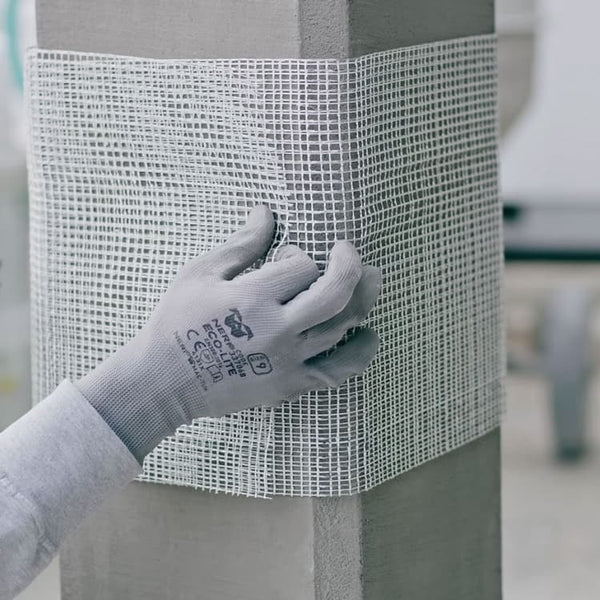
- First base coat and glass-fibre mesh: the alkali-resistant mesh goes into the still-fresh coat.
- Second base coat: covers the mesh completely and gives a flat surface.
- Finish coat: a coloured thin-coat render (decorative render), with a primer depending on the system.

The ETICS build-up from the wall outwards. The six Kerakoll products are the adhesive and both base-coat layers.
The adhesive and the base coat have four jobs:
- They fix. The adhesive holds the board on the wall; the dowels add to it.
- They reinforce. The mesh embedded in the base coat works against cracks and impacts.
- They level. The two base coats give a flat, even ground for the finish coat.
- They work as a system. The adhesive has to suit the board, the mesh and the finish coat. Testing of the system proves this (see ETA below).
All six Kerakoll products are adhesive and base coat in one: the same bag goes on the back of the board and into the mesh. No separate base-coat material is needed.
Adhesive, base coat, embedding mortar: one material, several names
The trade uses several words for the same layer. In this article we use them as follows:
| Adhesive | Base coat | Finish coat | |
|---|---|---|---|
| Other names | adhesive mortar | skim coat, embedding mortar, meshing | thin-coat render, decorative render |
| What is it for? | fixing the board to the wall | embedding the mesh, in two coats | the façade's colour and texture |
| Which layer (above)? | 2 | 4–5 | 6 |
| The six Kerakoll products | yes | yes | no, a separate product |
Which insulation board can be on the wall?
- Polystyrene (EPS, in Hungary colloquially "nikecell"): white or grey foam board made from expanded beads. This is the most common façade board.
- Extruded polystyrene (XPS): closed-cell, coloured board, typically on the plinth.
- Mineral wool (stone and glass wool, abbreviated MW): fibrous board. Used on whole façades and as fire barriers.
- Other boards: wood fibre, cork, calcium silicate, polyurethane, phenolic resin, aerogel.

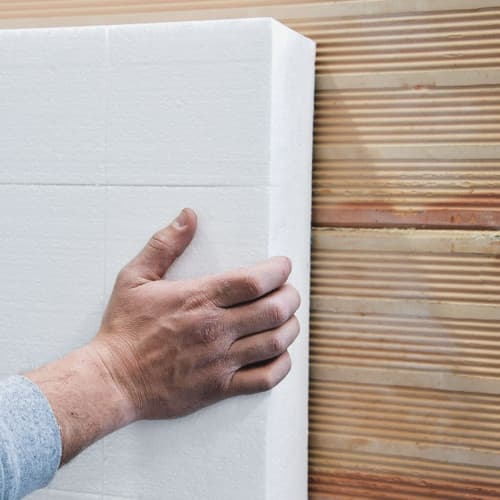
White and grey polystyrene (EPS), fibrous stone wool and pressed wood fibre. The board type decides which adhesive is suitable.
A polystyrene façade can have mineral wool on it too. Under the Hungarian fire-protection technical guideline (TvMI 1.7:2025.02.01, section 4.3.5.1), for a polystyrene system thicker than 10 cm one accepted solution is a band of class A1 or A2 material at least 20 cm high above the openings, for example in stone wool. So one façade can carry two board types, and the adhesive has to suit both. Whether a band is needed, and where, is for the designer to decide.
What does ETA mean, and why does it matter?
An ETA (European Technical Assessment) does not certify a bag but the whole insulation system. For rendered façade systems the European Assessment Document EAD 040083-00-0404 applies. Kerakoll's system is Klimaexpert, in a polystyrene (ETA EPS) and a mineral-wool (ETA MW) version. Conformity is valid only together with the system components named in the ETA (board, mesh, dowel, render). So system components should not be mixed, and if the designer specifies a system, that is the one to follow.
How to read the technical data sheet
- Adhesion (N/mm²): the force needed to pull the set adhesive off the substrate. The higher it is, the stronger the bond. Data sheets mostly give a minimum (≥). For a value measured on the insulation board, what counts is that the board tears, not the bond.
- Compressive strength (MPa): how much pressure the set material can take before it crushes.
- Water-vapour diffusion resistance factor (μ): how much the layer slows down vapour passing through. The lower it is, the more vapour it lets through.
- Reaction-to-fire class (EN 13501-1): A1 is a non-combustible material. A2-s1,d0 is practically non-combustible, gives little smoke and does not drip while burning.
- Pot life: how long the mixed material can be used. On a large area this decides how much can be mixed at once.
The hidden problem: the board, the substrate and the workmanship
Many faults in façade insulation come not from the bag but from the workmanship. The ÉMI draft guideline for contractors (ETICS-THR kivitelezése, 2019) lists typical faults such as these:
- Diagonal crack from a window corner: the diagonal patch mesh at the corners is missing.
- Wavy surface: the boards were dowelled before the adhesive had set.
- Mesh drawn in at the dowels: dowels sunk too deep.
- Layers coming away in sheets in spring: the render was applied in too cold weather, or froze before it set.

A diagonal crack from the window corner. According to the ÉMI draft guideline, a typical cause is a missing diagonal mesh patch at the corner.
Two more common faults: if a board is still being adjusted when the adhesive starts to set, it bonds weakly and can even come away. If the base coat is too thin, or the second coat does not fully cover the mesh, the mesh shows through.
The board type matters too. A polystyrene system moves with heat and cold, and the base coat has to follow. The adhesive has to wet fibrous mineral wool, otherwise it does not bond well. With wood fibre and cork, vapour permeability can also be a factor.
These are the limits to watch:
- Bonded area: with perimeter-and-dab bonding (a continuous strip along the board edge, dabs in the middle) at least 40% of the board should be bonded (ÉMI). Kerakoll's data sheets also describe full-bed bonding; which method is needed depends on how uneven the substrate is.
- Base coat: two coats with the mesh between them. For certified systems the minimum mesh-embedding thickness is mostly 3–3.5 mm, and mesh strips overlap by at least 10 cm (ÉMI).
- Weather: the six Kerakoll products may be applied between +5 °C and +30 °C, and the finished surface must be protected from rain for at least 48 hours. In cold, humid weather setting can be delayed by several days (ÉMI).
- Substrate: it must be flat, sound, clean and dry. On an unsound substrate Rasobuild Eco Consolidante consolidant goes first. Unevenness must first be levelled with a Geolite or Geocalce product, not with the adhesive. The adhesive must not go on gypsum walls, damp substrates, wood or metal.

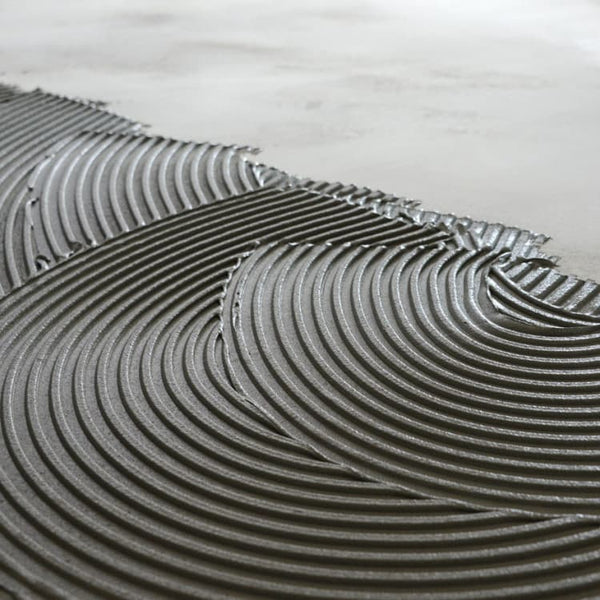
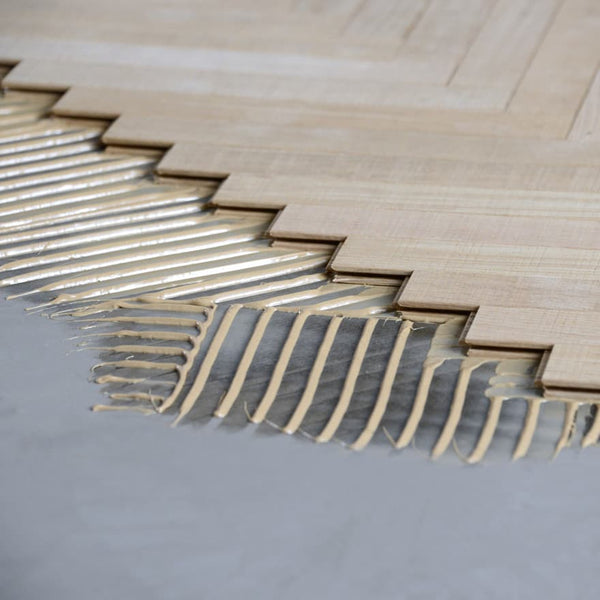
Perimeter-and-dab bonding: a bead around the edge of the board and dabs in the middle. Once pressed on, at least 40% of the board must be bonded (ÉMI).
Why does this matter for the whole job? Façade work is done from scaffolding. If a fault has to be repaired later, the scaffolding goes up again, and the finish coat is redone together with the base coat. Scaffolding alone costs ≈ HUF 1,200–2,000/m² including erection and dismantling, for a family house (JóSzaki, 2026).
How to find out what is needed
A few simple checks help. They are rough checks and do not replace a professional assessment.
- Look at the plans. The energy or construction design gives the board type, the thickness and the fire barriers. If the designer specifies a system, follow it.
- Look at the board. Beaded foam board: polystyrene (EPS). Coloured, closed-cell board without beads: XPS. Fibrous, soft board: mineral wool. Brown, pressed fibrous board: wood fibre.
- Rub test. Run your palm over the wall. If it comes away dusty, or the render crumbles, the substrate is not sound: consolidate it first.
- Tap test. If old render sounds hollow when tapped, it has come away from its base. Repair it before bonding.
- Straightedge test. Hold a long, straight batten against the wall. If a larger gap shows under it, level the wall first.
- Trial bonding. Bond a few small pieces of board and tear them off a few days later. If the board tears, the substrate holds. If the adhesive comes off with the render, the substrate is weak.
- Damp patches, salt efflorescence. The adhesive must not go on a damp substrate. The cause of the damp has to be removed first.
What sets the six Kerakoll ETICS adhesives apart?
All six are one-component powders of mineral origin, mixed with water only. Latex or other additives must not go in. The binder of Klima Light Calce is NHL natural hydraulic lime; the data sheets of the other five name no binder.
The shared properties are not true for all six:
- Klimaexpert ETA system (EAD 040083-00-0404): the polystyrene (EPS) system includes Klima Fix, Keraklima Eco, Keraklima Eco Granello, Klima Flex and Klima Light. The mineral-wool (MW) system includes Klima Fix, Keraklima Eco Granello and Klima Light Calce.
- Also for fire-protection Klimaexpert systems: all six products.
- Reaction-to-fire class A1 (non-combustible): five products. Klima Flex is class A2-s1,d0.
- Can also be applied with a plastering machine: all six products.
- Pot life at least 5 hours: five products. The Klima Fix data sheet gives no pot life. For the similar products surveyed it is ≈ 1–3 hours (see below).
- EC 1 plus (GEV-Emicode), i.e. certified very low emissions: all six products.
- GreenBuilding Rating 4 or 5: all six products. This is Kerakoll's own environmental rating: it shows how many of the five environmental criteria listed on the data sheet (regional minerals, recycled minerals, CO₂ emission, low VOC emission, recyclability) the product meets.
The manufacturer's figures apply at +23 °C and 50% relative humidity. In cold, humid weather drying takes longer.
The six Kerakoll ETICS adhesives and base coats


A polystyrene façade with a stone wool fire barrier above the opening. On a mixed wall like this, Klima Fix bonds both boards and is part of both ETA systems.


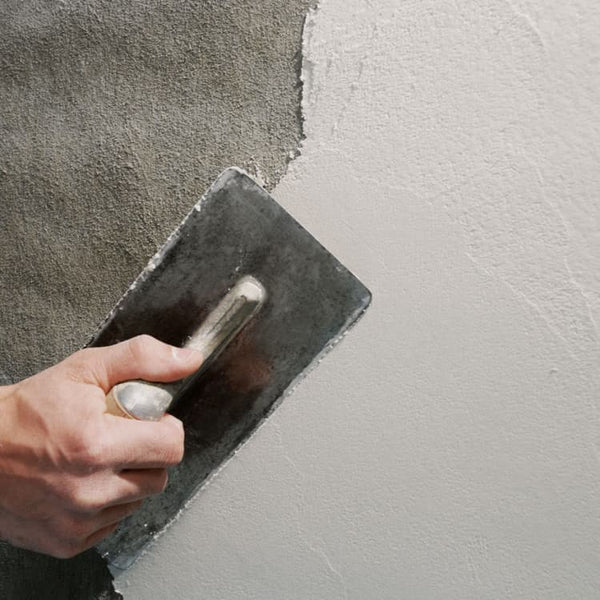
The alkali-resistant mesh goes into the fresh base coat, with strips overlapping by at least 10 cm. A diagonal mesh patch goes on the window corners. The second layer covers the mesh completely.


Wood fibre insulation boards on a brick wall. When the goal is a lime-based, vapour-open build-up on stone wool, wood fibre or cork, Klima Light Calce is made for it.
The family's seventh member, Klima HP, is a base coat only: a fibre-reinforced, hail- and impact-resistant base coat for new and damaged systems. It does not bond boards.
Comparison table
| Klima Fix | Keraklima Eco Granello | Keraklima Eco | Klima Flex | Klima Light | Klima Light Calce | |
|---|---|---|---|---|---|---|
| Type | mineral | mineral, deformable | mineral, fine-grained | mineral, flexible | mineral, lightweight | NHL lime, lightweight |
| On polystyrene (EPS, XPS) | yes | yes | yes | yes | yes | no |
| On stone and glass wool | yes | yes | yes | yes | yes | yes |
| ETA system: polystyrene (EPS) | yes | yes | yes | yes | yes | no |
| ETA system: mineral wool (MW) | yes | yes | no | no | no | yes |
| Grain size | 0–1.4 mm | 0–1.4 mm | 0–1 mm | 0–1.4 mm | 0–1.2 mm | 0–1.2 mm |
| As adhesive (kg/m²) | ≈ 2.5–4 | ≈ 3–5 | ≈ 2.5–4 | ≈ 3.5–5 | ≈ 2–3.5 | ≈ 2–3.5 |
| As base coat (kg/m²/mm) | ≈ 1.5 | ≈ 1.6 | ≈ 1.5 | ≈ 1.6 | ≈ 1 | ≈ 0.95 |
| Max. thickness as adhesive | 15 mm | 15 mm | 15 mm | 15 mm | 20 mm | 20 mm |
| Adhesion to concrete (28 days) | ≥ 0.9 N/mm² | ≥ 1.0 N/mm² | ≥ 0.9 N/mm² | ≥ 1.1 N/mm² | ≥ 0.8 N/mm² | ≥ 0.8 N/mm² |
| Compressive strength | ≥ 7 MPa | ≥ 10 MPa | ≥ 8 MPa | ≥ 10 MPa | ≈ 4 MPa | ≈ 8 MPa |
| Vapour diffusion resistance (μ) | 5/20* | 23 | 16 | 15 | 11 | 10 |
| Reaction-to-fire class | A1 | A1 | A1 | A2-s1,d0 | A1 | A1 |
| Pot life | not stated | ≥ 5 hours | ≥ 5 hours | ≥ 5 hours | ≥ 5 hours | ≥ 5 hours |
| Colour | white, grey | white | white, grey | extra white | white | beige |
| Pack | 25 kg | 25 kg | 25 kg | 25 kg | 20 kg | 20 kg |
| GreenBuilding Rating | 5 (white), 4 (grey) | 5 | 4 | 5 | 5 | 5 |
According to Kerakoll's technical data sheets, at +23 °C and 50% relative humidity. "≥" is the minimum value declared by the manufacturer, "≈" an approximate value. The "On stone and glass wool" row shows the manufacturer's recommendation; the ETA rows show which tested system the product is listed in. * Klima Fix's μ is the tabulated value per EN 1745.
More expensive? What does it really cost?
The bag price is misleading, because pack sizes and consumption differ. The lightweight products, for example, need fewer kilograms for the same area. So the material cost per square metre is the figure to look at.
| Product | Price (gross) | HUF/kg | ≈ kg/m² (adhesive + 4 mm base coat) | ≈ HUF/m² |
|---|---|---|---|---|
| Klima Fix, grey | HUF 10,850 / 25 kg | ≈ 434 | ≈ 9.3 | ≈ 4,010 |
| Klima Fix, white | HUF 11,250 / 25 kg | ≈ 450 | ≈ 9.3 | ≈ 4,160 |
| Klima Light | HUF 14,000 / 20 kg | ≈ 700 | ≈ 6.8 | ≈ 4,730 |
| Klima Light Calce | HUF 14,950 / 20 kg | ≈ 748 | ≈ 6.6 | ≈ 4,900 |
| Keraklima Eco (white or grey) | HUF 14,300 / 25 kg | ≈ 572 | ≈ 9.3 | ≈ 5,290 |
| Keraklima Eco Granello | HUF 14,950 / 25 kg | ≈ 598 | ≈ 10.4 | ≈ 6,220 |
| Klima Flex | HUF 15,900 / 25 kg | ≈ 636 | ≈ 10.7 | ≈ 6,770 |
masterworks.hu gross prices at the time of writing (November 2026), without waste allowance; the current price is shown on the product page. Calculation: the middle of the data-sheet range as adhesive, and a 4 mm, two-coat meshed base coat (assumption; according to the ÉMI draft guideline the minimum mesh-embedding thickness for certified systems is mostly 3–3.5 mm).
The table shows two things:
- Klima Fix is the cheapest, and it suits every board type. In grey it is ≈ HUF 4,000/m², and it is tested in both the polystyrene and the mineral-wool ETA system.
- The lightweight products are cheaper than their bag price suggests. Klima Light and Light Calce are the dearest per kilogram, yet per square metre they are cheaper than Keraklima Eco, Granello and Flex, because less material is needed.
What do similar products cost?
We surveyed ETICS adhesives and base coats sold in Hungary: the manufacturer data sheets and gross web-shop prices of 15 products, plus the prices of nine cheap bagged polystyrene adhesives (11 November 2026). The material cost was calculated with the same method as for the Kerakoll products.
| Category | Products surveyed | ≈ HUF/m² | Kerakoll equivalent (≈ HUF/m²) |
|---|---|---|---|
| Cheap bagged polystyrene adhesive | 9 | 1,020–1,720 | — |
| Universal adhesive-base coat (polystyrene and stone wool) | 6 | 1,010–3,420 | Klima Fix 4,010–4,160; Keraklima Eco Granello 6,220 |
| White, high-performance polystyrene adhesive-base coat | 3 | 2,890–4,350 | Keraklima Eco 5,290; Klima Flex 6,770 |
| Lightweight adhesive-base coat | 2 | 1,690–3,900 | Klima Light 4,730 |
| Stone-wool adhesive and base coat | 6 | 1,010–2,890 | Klima Light Calce 4,900 |
| NHL lime-bound adhesive-base coat | 0 | — | Klima Light Calce 4,900 |
Lowest gross web-shop price found for each product, not sale prices where another price was available. The cheap bagged products are one Hungarian specialist shop's prices (two of them on sale), calculated with the same consumption as Klima Fix (assumption). Some manufacturers state base-coat consumption without a layer thickness, or combined with bonding; for these the real 4 mm cost may be higher. One product can appear in more than one category. At contractor (project) prices the differences may change. The product-by-product survey data (data sheet, web shop, price, date) are available on request.
Among the products surveyed, Kerakoll is the most expensive per square metre in every category. Against the technically closest products, however, the gap is much smaller than against the category as a whole (see the 150 m² example below).
What do you get for the extra cost?
Compared with the surveyed products' manufacturer data sheets, these differences can be documented:
- Longer pot life. The mixed material of Keraklima Eco, Granello, Flex, Light and Light Calce can be used for at least 5 hours. Of the surveyed products that state a pot life, none exceeds ≈ 3 hours, and most give 1–2 hours. This matters on large areas and in warm weather. The Klima Fix data sheet gives no pot life.
- European system certification. All six Kerakoll products are part of the Klimaexpert ETA system. Of the 15 surveyed products, the Hungarian documentation of five names an ETA; the rest show a national approval (NMÉ, ÉME, THR) or none. On Hungarian jobs the national approval is also accepted; the ETA matters for a designer's specification and on larger projects.
- Emission and environmental data on the data sheet. EC 1 plus, EPD and GreenBuilding Rating for all six Kerakoll products. The surveyed products' Hungarian data sheets state no emission class; that does not mean they have none.
- Less material from the lightweight products. As a base coat, Klima Light needs ≈ 1 and Light Calce ≈ 0.95 kg/m² per millimetre. Of the surveyed products that state this per millimetre, the others need ≈ 1.2–1.5 kg or more. On 150 m² with a 4 mm base coat, that is ≈ 130–360 kg less powder on the scaffolding.
- A lime-based adhesive-base coat. We found no NHL natural hydraulic lime-bound ETICS adhesive and base coat in the Hungarian range other than Klima Light Calce.
Where it is not better:
- Price: the most expensive in every category.
- A1 fire class, white colour, +50% yield: surveyed products offer these too. The "+50%" holds against the usual ≈ 1.5 kg/m²/mm; it means 33% less material.
- Board types: the ETA of Keraklima Eco, Klima Flex and Klima Light covers polystyrene only, although their data sheets also list stone wool. Some of the similar white and lightweight products also have a stone-wool system approval, or their manufacturer also recommends them for stone wool.
- Compressive strength: several competitors declare a higher value; for a base coat this is not a quality measure on its own.
- Adhesion: the figures cannot simply be compared. Some manufacturers state the minimum they guarantee, others the test's minimum requirement or a single measured value.
A 150 m² façade as an example
A polystyrene façade insulation job, with material, labour and finish coat but without scaffolding, costs ≈ HUF 22,500/m² on average (over 10 cm), and with stone wool ≈ HUF 30,000/m² (10 cm), according to JóSzaki's 2026 gross average prices. On a 150 m² family-house façade (assumption) we compare the Kerakoll products with the technically closest surveyed product. The last column is the key figure: how much more the whole façade costs, in per cent, with the Kerakoll adhesive and base coat.
| Kerakoll product | Closest surveyed product | Difference, HUF/m² | On 150 m² | Share of the whole façade price |
|---|---|---|---|---|
| Klima Fix, grey | universal, ETA for polystyrene and stone wool, A1 (≈ HUF 3,420/m²) | ≈ +600 | ≈ +HUF 90,000 | ≈ 3% |
| Klima Fix, white | the same | ≈ +750 | ≈ +HUF 112,000 | ≈ 3% |
| Keraklima Eco Granello | the same | ≈ +2,800 | ≈ +HUF 421,000 | ≈ 12% |
| Keraklima Eco | with ETA, A1; price of the grey version (≈ HUF 3,640/m²) | ≈ +1,660 | ≈ +HUF 248,000 | ≈ 7% |
| Klima Flex | white, with ETA, A2-s1,d0, machine application (≈ HUF 4,350/m²) | ≈ +2,430 | ≈ +HUF 364,000 | ≈ 11% |
| Klima Light | lightweight, no ETA on the data sheet (≈ HUF 3,900/m²) | ≈ +830 | ≈ +HUF 124,000 | ≈ 4% |
| Klima Light Calce | no NHL equivalent found; cement-based stone-wool adhesives (≈ HUF 1,010–2,890/m²) | ≈ +2,010 … +3,880 | ≈ +HUF 301,000 … 583,000 | ≈ 7–13% |
Adhesive + 4 mm base coat. Whole façade price: 150 m² × HUF 22,500 ≈ HUF 3.4 million with polystyrene; in the Light Calce row 150 m² × HUF 30,000 = HUF 4.5 million with stone wool. "Closest": the surveyed product most similar in certification and properties; brand names are not given. Two surveyed products fit the description in the Klima Fix and Granello rows; the table shows the one that also states adhesion to concrete. Against the other (≈ HUF 2,010/m²) the gap is ≈ 9–19% of the façade price. Mesh, dowels, boards and finish coat are needed on both routes, so the table shows only the adhesive and base coat. Against the average cheap bagged polystyrene adhesive the gap is larger: ≈ HUF 2,750–5,500/m².
Where the advantages above matter — a longer pot life on a large area, a designer's ETA specification, emission data, lighter material, a lime-based build-up — the gap against the closest similar product is ≈ 3–13% of the façade price. Where none of them matters, the extra cost is harder to justify, and a similarly certified system can be a good choice too. If the façade is built with another manufacturer's certified system, that system's adhesive belongs in it. System components should not be mixed.
The cost of risk
The most expensive option is a badly built system. If the boards come away, the whole system has to be redone: on 150 m² that is ≈ HUF 3.4 million, calculated at the average price of a new polystyrene system, not counting scaffolding or the removal and disposal of the old system. Even if only the base coat cracks or the mesh shows through, the scaffolding has to go up again (≈ HUF 180,000–300,000 for 150 m²), and the finish coat is redone together with the base coat. So an adhesive that suits the board and the substrate, a meshed base coat of the right thickness and attention to the weather are worth more than the money saved on the bag.
In short
- Mixed or mineral-wool façade, good price: Klima Fix — the cheapest Kerakoll, in both the polystyrene and the mineral-wool ETA system; against the closest similar product it adds ≈ 3% to the façade price.
- Mineral-wool or mixed façade, higher declared strength: Keraklima Eco Granello — more coverage in one coat, but ≈ 50% dearer than white Klima Fix.
- Polystyrene, fine base coat or grey colour: Keraklima Eco.
- Polystyrene, flexible, extra-white layer, long pot life: Klima Flex — the most expensive of the six per square metre.
- Large polystyrene façade, machine work: Klima Light — for polystyrene, the least base-coat material per millimetre in the survey, fewer bags on the scaffolding.
- Stone wool, wood fibre, cork, lime-based build-up: Klima Light Calce — according to our survey, the only NHL lime-bound ETICS adhesive-base coat in the Hungarian range.
Which insulation adhesive do you need? Deciding by the façade
Start with the board and the wall, not with the bag. If unsure, look at the plans and do the checks above.
- Polystyrene (EPS) boards, a simple façade: Klima Fix; for a finer base coat or in grey, Keraklima Eco.
- Polystyrene boards with stone-wool fire barriers: Klima Fix or Keraklima Eco Granello — both are listed in the polystyrene and the mineral-wool ETA system.
- A full stone-wool façade: Klima Fix or Keraklima Eco Granello; for a lime-based, vapour-permeable layer, Klima Light Calce.
- Wood-fibre, cork or calcium-silicate boards: Klima Light Calce.
- Large polystyrene area, machine application, thicker base coat: Klima Light.
- Polystyrene façade where a flexible, extra-white layer matters: Klima Flex.
- Façade exposed to hail or impact, or repair of a damaged system: for the base coat, Klima HP; the board is fixed with the adhesive specified in the Klimaexpert system description.
- Dusty, crumbling substrate: first Rasobuild Eco Consolidante, then the adhesive that suits the board.
- Uneven wall: first level it with a Geolite or Geocalce product, not with the adhesive.
- Damp, salt-affected wall: the cause of the damp has to be dealt with first; see our article on damp walls.
- Gypsum-rendered wall: the manufacturer does not recommend it; agree the build-up before work starts.
- No insulation, you only want to skim the old façade: that calls for a façade skim coat, see the Skim coat or levelling plaster? article.
All products: ETICS adhesives and base coats. Choosing the finish coat is covered in our decorative render guide.
Frequently asked questions
Which insulation adhesive works for polystyrene and mineral wool at the same time (on a "dryvit" façade)?
An insulation adhesive that bonds and skims both boards and that the manufacturer recommends for both. Kerakoll Klima Fix and Keraklima Eco Granello are also part of both the Klimaexpert polystyrene (EPS) and the mineral-wool (MW) ETA system. The data sheets of Keraklima Eco, Klima Flex and Klima Light also list stone wool, and all three are suitable for fire-protection Klimaexpert systems. Which system the façade with fire barriers follows is for the designer to specify. Klima Fix is cheaper; Granello declares higher adhesion to concrete and higher compressive strength.
How much insulation adhesive and base coat is needed per m² of façade?
Kerakoll insulation adhesives need ≈ 2–5 kg/m² for bonding and ≈ 0.95–1.6 kg/m² per millimetre for the base coat, depending on the product. With bonding (taking the middle of the range) and a 4 mm, two-coat base coat, Klima Fix uses ≈ 9 kg/m² in total, the lightweight Klima Light ≈ 7 kg/m². The amount of adhesive also depends on the bonding method and the substrate.
How thick should the meshing, i.e. the base coat on the insulation, be?
Meshing consists of two base coats with alkali-resistant glass-fibre mesh between them: the mesh goes into the first, still-fresh coat, and the second covers it completely. According to the ÉMI draft guideline, the minimum mesh-embedding thickness for certified systems is mostly 3–3.5 mm, and mesh strips overlap by at least 10 cm. Klima Light and Light Calce can be applied as a base coat up to 15 mm in two coats.
A lightweight insulation adhesive for polystyrene or for mineral wool: Klima Light or Klima Light Calce?
For polystyrene the white Klima Light; for mineral and natural boards (stone wool, wood fibre, cork) the beige, lime-based Klima Light Calce. Klima Light is part of the polystyrene (EPS), Light Calce of the mineral-wool (MW) Klimaexpert ETA system. Both are lightweight and high-yield: up to +50% when skimming compared with traditional adhesives and base coats, according to the manufacturer.
Is a more expensive insulation adhesive worth it, or will a cheap bagged polystyrene adhesive do?
A more expensive insulation adhesive is worth it where its properties solve a real task. In our survey the Kerakoll ETICS adhesives are the most expensive per square metre in every category; against the technically closest products the difference on a 150 m² façade is ≈ HUF 90,000–420,000, and for Light Calce, for which we found no NHL equivalent, ≈ HUF 300,000–580,000. In return they give a longer pot life (at least 5 hours, except Klima Fix), emission data on the data sheet, less material in the lightweight versions and a lime-based layer in Light Calce. All six have a European ETA; of the 15 surveyed products, the Hungarian documentation of five names one. Whichever manufacturer's system is chosen, the adhesive should be part of that certified system.
When can an insulation adhesive not be used?
Kerakoll insulation adhesives are not suitable for gypsum walls and gypsum-based renders, damp substrates, wood and metal. They are not made for bonding ceramic or stone cladding either, and the wall's unevenness should not be filled with them. They must not be applied below +5 °C or above +30 °C, and they may be mixed with water only.
What does it mean that an insulation adhesive is part of an ETA system?
It means the insulation adhesive was tested together with the whole system: the European Technical Assessment (ETA) under EAD 040083-00-0404 assesses the system as a whole. Conformity is valid only together with the system components named in the ETA (board, mesh, dowel, render). Kerakoll's system is Klimaexpert, in a polystyrene (EPS) and a mineral-wool (MW) version.
Can an insulation adhesive and base coat be applied DIY?
DIY application is not recommended: Kerakoll insulation adhesives and base coats are made for professionals. An insulation system needs scaffolding, dowelling and meshing experience, and the typical faults listed in the ÉMI draft guideline (cracks at the corners, a wavy surface, detachment) come from the workmanship. We also install façade insulation.
Let us help you choose
Not sure which one suits your façade? Tell us what the wall is like, which insulation board goes on it, how large the area is, and whether there is a designer's specification. We will suggest a build-up. You can also ask for a material + labour package quote: we install façade insulation too. Kerakoll materials carry the 5-year Kerakoll material warranty.
hello@masterworks.hu · +36 70 400 2040
Masterworks — official Kerakoll distributor in Hungary.