


Screed: what it's for, and why fast-drying screed pays off. Comparing five Kerakoll screeds
A floor's looks depend on its covering, but its lifespan depends on what lies underneath. Parquet, tiles or microcement sit on a layer a few centimetres thick: the screed. When it's good, nobody thinks about it. When it's bad, the parquet cups, the tiles crack, and the whole floor has to be redone.
This guide first explains in plain terms what screed is, what it does, and why drying time is its most important property. Then it introduces Kerakoll's five screeds: the Keracem binder and the ready-mixed Keracem Pronto, Keracem Prontoplus, Massetto Premix and Rekord Pronto. It compares them and works out when the more expensive bag pays off against a conventional, cheaper screed.
What is screed, and what is it for?
Screed is a cement-based layer laid over the structural floor slab or the ground-bearing concrete, and the floor covering goes directly on top of it. It is typically 4–8 cm thick. It does not carry the building; that is the slab's job. It carries the floor, and it has four jobs:
- It creates a flat, level surface. A bare slab is uneven, falls in places and has pipes and cables running across it. The screed covers all of that and gives a plane that a covering can be bonded to.
- It spreads the load. Furniture, footsteps and office chairs create point loads; the screed distributes them over the insulation underneath.
- It houses underfloor heating. The heating pipes run inside the screed, which stores the heat and releases it evenly.
- It carries impact-sound and thermal insulation. A floating screed "floats" on an insulation board, so footsteps don't carry through to the neighbours below.

The layers of a modern floor: slab, insulation, membrane, underfloor heating, screed, adhesive and parquet.
Bonded or floating screed?
A bonded screed is fixed directly to the concrete with a bonding bridge. It can be thinner (from 20 mm with the Kerakoll products) and is common in renovations where height is limited.
A floating screed lies on a membrane or insulation board and touches neither the base nor the walls; a perimeter strip separates it from the walls. This is the standard solution in apartments, because it makes impact-sound insulation and underfloor heating work. It has to be thicker (typically from 40–50 mm), because it must hold itself together.
What does CT-C30-F6 mean?
Screeds are classified under EN 13813. CT means a cementitious screed. The number after C is the compressive strength (N/mm²); the number after F is the flexural strength. A CT-C20-F4 screed therefore has at least 20 N/mm² compressive and 4 N/mm² flexural strength. Homes typically get a C16–C20 screed; heavily loaded commercial or industrial floors need higher values. Under joint-free Cementoresina microcement, Kerakoll recommends the CT-C60-F7 Prontoplus.
The hidden problem: moisture
Screed is made with water, and most of that water has to evaporate before the floor can be covered. This is checked with the CM method (calcium carbide test). The usual limits are:
- parquet, laminate, vinyl, resin: max. 2.0 CM%
- the same over underfloor heating: max. 1.8 CM%
- ceramic and stone: less sensitive to moisture, but the adhesive manufacturer's requirements still apply
If the covering goes on too early, the trapped moisture can't escape. Parquet absorbs it and cups, board edges curl, resilient coverings delaminate, and the adhesive doesn't bond properly. This isn't a cosmetic defect: the floor has to be torn up.
How long does a conventional screed take to dry?
The old rule of thumb is one week per centimetre. According to technical literature, that only holds up to about 4 cm: for thicker layers, drying time grows with the square of the thickness, not linearly. A 5 cm conventional cement screed needs 5–6 weeks even in good conditions to reach the moisture level parquet requires. In cold, humid weather or with poor ventilation, it often takes months.
Underfloor heating slows things down further. Under EN 1264-4, the first heat-up of a conventional cement screed can start 21 days after laying at the earliest. Then comes a heating protocol of at least one week, and then another moisture test.
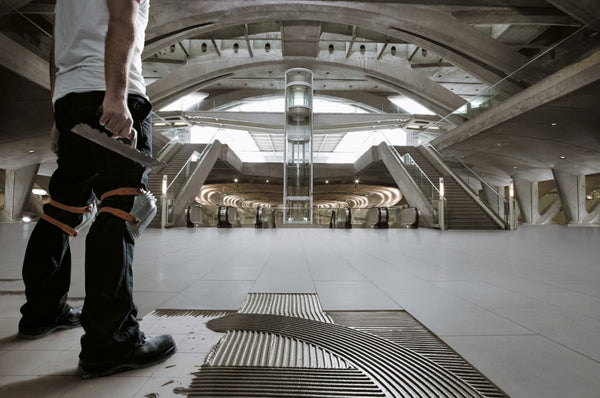
So in most renovations, the screed is the critical path: until it is dry, the parquet fitter, the tiler and the furniture all wait.

Conventional screed takes weeks to dry — meanwhile the parquet waits in its boxes.
What makes Kerakoll screed different?
Kerakoll screeds are mineral, fast-drying screeds. The difference lies in the special hydraulic binder: it sets at a normal pace but dries fast. That is why the screed reaches the moisture level needed for covering in a few days (in a single day for Rekord Pronto), not weeks.
What they have in common:
- A dimensionally stable base. The Keracem family (Keracem, Pronto, Prontoplus) offers outstanding dimensional stability; the Keracem binder is shrinkage-compensated and releases moisture evenly.
- Suitable for underfloor heating, which can be started after a few days.
- Very low emissions. EC 1 plus and French A+ indoor ratings, so they are suitable for homes and children's rooms.
- Made for bonded coverings: ceramic, stone, parquet and, depending on the type, resilient and resin coverings.
One important condition: the manufacturer's times apply at +20 °C and 65% relative humidity, and a CM test is required before covering. Fast screed doesn't replace measuring, but it reaches the right result much sooner.
The five Kerakoll screeds


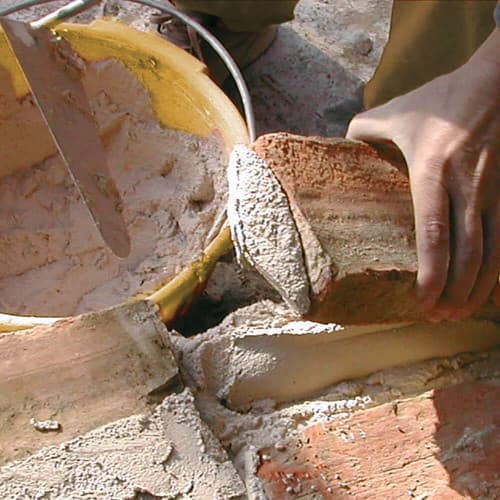
The Keracem binder is mixed with sand on site — on large areas, a screed pump is the most economical way.


Joint-free Cementoresina microcement floor, laid on fibre-reinforced Keracem Prontoplus screed.


Comparison table
| Keracem (+ sand) | Massetto Premix | Keracem Pronto | Keracem Prontoplus | Rekord Pronto | |
|---|---|---|---|---|---|
| Type | binder | ready mix | ready mix | ready mix, fibre-reinforced | ready mix |
| Strength | ≥ 32 / ≥ 45 N/mm²* | CT-C16-F4 | CT-C30-F6 | CT-C60-F7 | CT-C40-F7 |
| Walkable | ≈ 8 h | ≈ 8 h | ≈ 8 h | ≈ 8 h | ≈ 3 h |
| Ceramic (5 cm) | ≈ 24 h | ≈ 24 h | ≈ 24 h | ≈ 24 h | ≈ 6 h |
| Parquet (5 cm) | ≈ 5 days | ≈ 7 days | ≈ 5 days | ≈ 3 days | ≈ 24 h |
| First heat-up | after 5 days | after 5 days | after 5 days | after 5 days | after 1 day |
| Outdoors | yes | yes | yes | yes | no |
*28-day compressive strength at 200 and 250 kg/m³ dosage respectively. All times at +20 °C and 65% relative humidity, confirmed by CM test.
More expensive? What does it really cost?
A bag of fast screed costs more than a bag of conventional screed. The question isn't the price of the bag but what a square metre costs, and what waiting costs.
As a benchmark we used a widely available bagged cement screed (CT-C20, 40 kg, ≈ 20 kg/m²/cm). Its gross price in Hungarian online shops is around HUF 2,600–3,200; we used HUF 3,000. Kerakoll prices are masterworks.hu gross prices at the time of writing (September 2026).
Material cost for a 5 cm screed
| Screed | Price / bag | Material / m² (5 cm) | Cost / m² | Parquet (5 cm) |
|---|---|---|---|---|
| Conventional bagged (CT-C20) | ≈ HUF 3,000 / 40 kg | ≈ 100 kg | ≈ HUF 7,500 | ≈ 5–6 weeks |
| Keracem (250 kg/m³) + sand | HUF 14,700 / 25 kg | 12.5 kg + sand | ≈ HUF 7,350 + sand | ≈ 5 days |
| Massetto Premix | HUF 3,100 / 25 kg | ≈ 90 kg | ≈ HUF 11,200 | ≈ 7 days |
| Keracem Pronto | HUF 4,300 / 25 kg | ≈ 85 kg | ≈ HUF 14,600 | ≈ 5 days |
| Keracem Prontoplus | HUF 5,500 / 25 kg | ≈ 85 kg | ≈ HUF 18,700 | ≈ 3 days |
| Rekord Pronto | HUF 11,250 / 25 kg | ≈ 85 kg | ≈ HUF 38,300 | ≈ 24 hours |
Two things stand out right away:
- Per m², the Keracem binder costs roughly the same as a conventional bagged screed, plus ≈ 80 kg/m² of locally sourced sand. Parquet can go down after 5 days instead of 5–6 weeks. The condition is accurate dosing: here the sand quality and the binder–sand–water ratio are down to the contractor. For a disciplined contractor working large areas with a screed pump, it offers the best cost-to-time ratio.
- The ready-mixed Kerakoll screeds cost HUF 3,700–11,200 more per m² (Rekord Pronto aside). Within the total cost of a floor (covering, adhesive, labour), that is a small item.
When does it pay off? An 80 m² apartment
Take an 80 m² apartment renovation with a 5 cm floating screed and parquet. The screed material cost (assuming 40 days' drying for the conventional screed):
| Screed | Material for 80 m² | Extra vs conventional | Parquet sooner by | Pays off if one day's delay costs more than |
|---|---|---|---|---|
| Conventional (CT-C20) | ≈ HUF 600,000 | — | — | — |
| Massetto Premix | ≈ HUF 893,000 | ≈ +HUF 293,000 | ≈ 33 days | ≈ HUF 8,900 |
| Keracem Pronto | ≈ HUF 1,170,000 | ≈ +HUF 570,000 | ≈ 35 days | ≈ HUF 16,300 |
| Keracem Prontoplus | ≈ HUF 1,496,000 | ≈ +HUF 896,000 | ≈ 37 days | ≈ HUF 24,200 |
| Rekord Pronto | ≈ HUF 3,060,000 | ≈ +HUF 2,460,000 | ≈ 39 days | ≈ HUF 63,100 |
What does one day's delay cost? It varies by project, but typical items include:
- Rent or a second home while the renovated apartment can't be moved into. A monthly rent of HUF 300,000 is ≈ HUF 10,000 a day, which on its own covers the extra cost of Massetto Premix.
- Mortgage payments and utilities on a home that can't yet be lived in.
- Lost rental income on an apartment meant to be let.
- Lost revenue for a shop, office or restaurant. Here one lost day can mean hundreds of thousands of forints, which is why Rekord Pronto pays off.
- The project schedule. If the parquet fitter can't come, their next free slot may be weeks later. The site, scaffolding and rented equipment keep costing money in the meantime.
- For contractors: more projects in the same time. If screed drying is the bottleneck, fast screed closes the project weeks sooner. Even if a job earns no more on its own, the contractor can take on more projects in the same period. That means more customers, more repeat business and faster turnover.

Rekord Pronto: walkable after 3 hours, ready for tiles after 6 — the shop can reopen days sooner.
With underfloor heating the gap is even bigger. A conventional screed's first heat-up can start after 21 days, followed by at least a week of heating protocol. With Kerakoll screeds, heating can start after 5 days (1 day for Rekord Pronto), so covering can begin weeks sooner.
The cost of risk
The most expensive screed is the one that has to be redone. If parquet goes onto a conventional screed too early because of the deadline, the trapped moisture can ruin it. If the parquet costs HUF 30,000/m² supplied and fitted, an 80 m² apartment means HUF 2.4 million, before counting the demolition and the further delay.
It isn't only parquet. We have seen terraces bulge where the tiles went down long before the cheap screed had dried. Everything was wasted, the earlier work and the expensive tiles alike, and the whole terrace had to be torn up and redone. Against that, the extra cost of a fast screed is insurance: the floor is far more likely to be dry by the deadline, and the CM test confirms it before covering.

Terrace tiles laid on wet screed: bulged, debonded tiles — everything has to be redone.
A ready mix also reduces another risk. The quality of a site-mixed screed depends on the mix ratio. Too much water, too little cement or the wrong sand, and the floor ends up weak in patches, cracks and dusts. With a ready mix, only the water quantity needs watching. (That is also why the Keracem binder needs accurate dosing.)
In short
- Homes, when time matters: Massetto Premix costs ≈ HUF 3,700/m² more and pays off at a delay cost of just ≈ HUF 9,000 a day.
- Underfloor heating, outdoors, higher loads: Keracem Pronto gives CT-C30-F6 strength and parquet in 5 days.
- Microcement, resin, heavy loads: Keracem Prontoplus is the safe base; here strength isn't optional.
- Shops, offices, tight deadlines: Rekord Pronto, because a day of lost revenue costs more than its premium.
- Large areas, own sand and equipment: the Keracem binder delivers fast screed at close to conventional-screed prices, with accurate dosing.
Which screed do you need?
- Apartment renovation, ceramic or parquet, normal loads: Massetto Premix
- Underfloor heating, any bonded covering, indoors and outdoors: Keracem Pronto
- Cementoresina microcement, parquet after 3 days, heavy traffic: Keracem Prontoplus
- Tight deadline, indoors: Rekord Pronto
- Large area, own sand and mixer: Keracem
All five are in the screeds collection.
Frequently asked questions
What's the difference between screed and a levelling compound?
Screed is a thick (typically 4–8 cm) load-bearing layer that covers the slab's unevenness and the pipes. A levelling compound is a thin (a few mm), self-levelling layer applied over existing screed or concrete to create the final flat surface.
How much screed do I need per m²?
For ready-mixed screed, ≈ 16–18 kg per centimetre, so ≈ 80–90 kg/m² for 5 cm (3.2–3.6 bags). For the Keracem binder, ≈ 2–2.5 kg/m²/cm, plus sand.
Why is a CM test needed if the manufacturer states the time?
The manufacturer's times apply at +20 °C and 65% humidity. In cold or humid conditions, drying takes longer. So a CM test is always needed before parquet and resilient coverings. Electric moisture meters don't give reliable readings on these screeds.
Can't a conventional screed just be dried quickly with a dehumidifier?
Ventilation and dehumidifying help, but water still leaves the core of a thick layer slowly. In fast-drying screeds the special binder speeds up drying, so it is measured in days, not weeks.
Which screed goes under microcement?
For joint-free Cementoresina floors, Kerakoll recommends the fibre-reinforced Keracem Prontoplus. On a 5 cm layer, the finish can go on after ≈ 3 days.
Which one works outdoors or on a terrace?
Keracem, Keracem Pronto, Keracem Prontoplus and Massetto Premix are all suitable outdoors. Rekord Pronto is indoor only.
Can I lay it myself?
Laying screed is skilled work: it needs level guides, compaction, movement joints and perimeter strips. Mistakes show up in the floor covering, so this is best left to a professional.
We'll help you choose
Not sure which screed suits your project? Get in touch and we'll help you choose the right build-up. We also install screed: ask for a combined materials + labour quote.
hello@masterworks.hu · +36 70 400 2040
Masterworks — official Kerakoll distributor in Hungary.