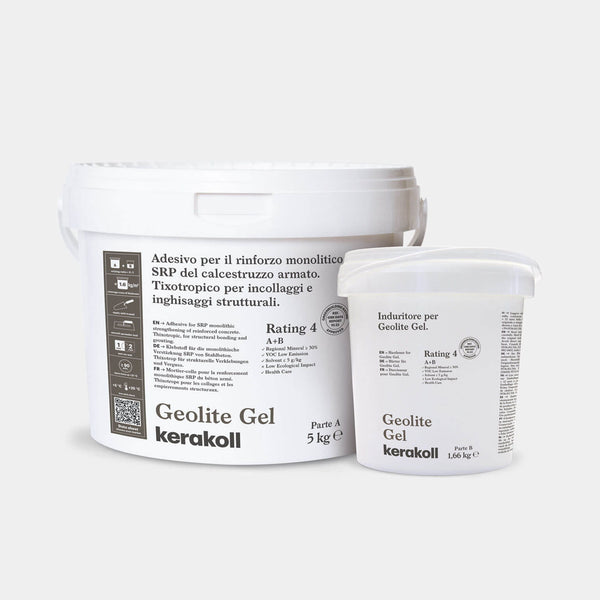
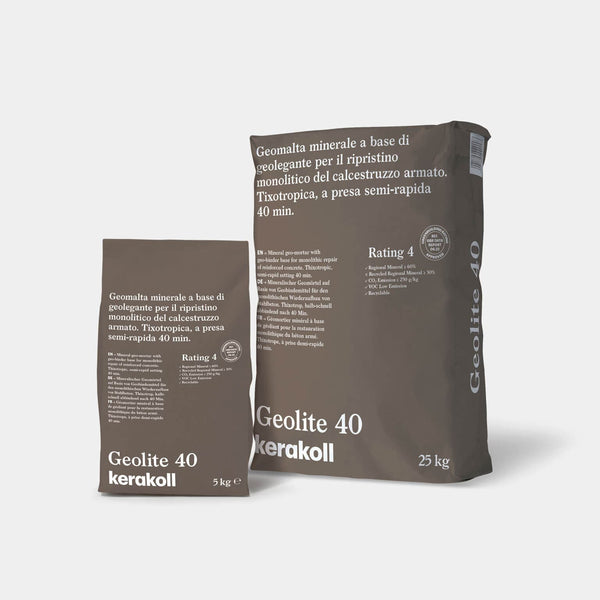
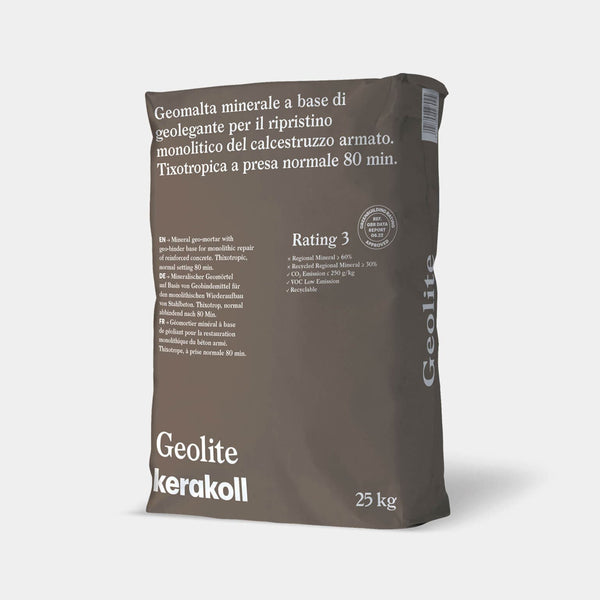
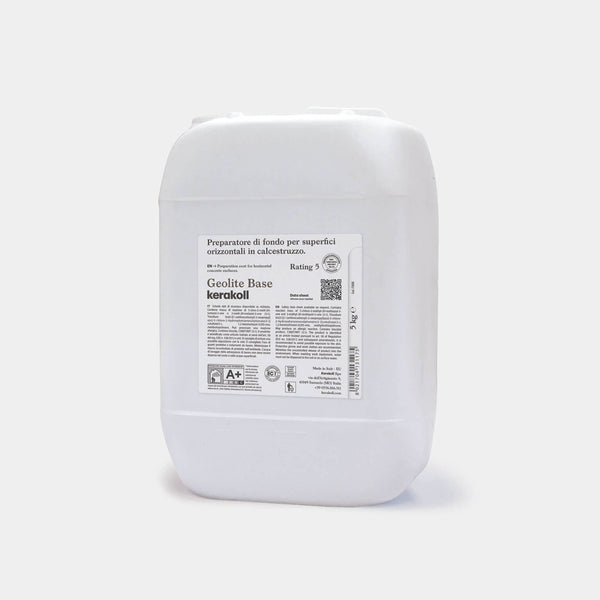
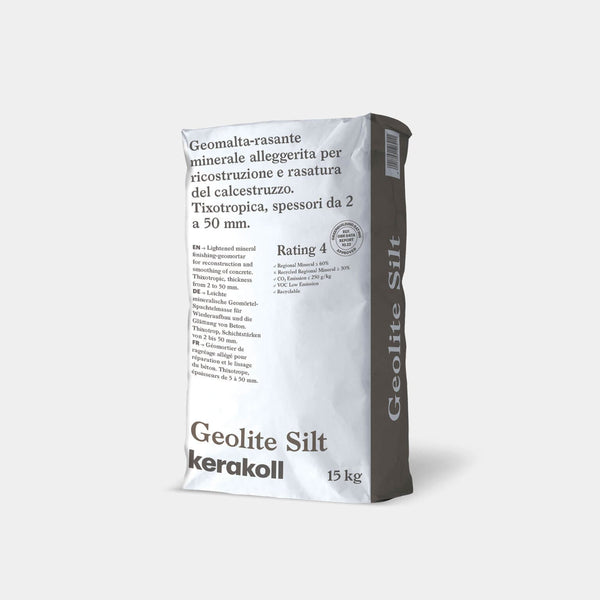
Are you bonding steel fabric reinforcement to reinforced concrete or anchoring rods? Ordinary adhesives slip in heat and do not penetrate pores. Geolite Gel is a two-component, thixotropic epoxy: it stays in place overhead, is workable in heat, and adheres to all substrates. This is the adhesive and anchoring material of the Kerakoll Geosteel SRP structural reinforcement system.
-
Wet impregnation of steel fabric reinforcement: two-component thixotropic epoxy — embeds the Geosteel G fabric and bonds it to the substrate (SRP)
-
Part of the system: the Kerakoll Geosteel SRP certified structural reinforcement system adhesive and matrix
-
Precision anchoring of rods and steel plates: pressed into holes or applied with a putty knife — excellent adhesion on all substrates
-
Does not melt in heat: thixotropic, workable at high temperatures — stays in place overhead and on vertical surfaces
-
Maintains shape under load: high Tg (glass transition temperature) — the bond remains solid even in heat
-
Does not spread flame: C-s2, d0 fire resistance Euroclass
-
Crack repair preparation: surface filling before Epofill injection
-
Accessories required for the complete system: not reinforcement by itself — the Geosteel G fabric and the prepared substrate form the complete SRP system
| Type |
Two-component thixotropic epoxy adhesive (structural) |
| Binder |
Epoxy, 2-component (“A” gray + “B” beige paste) |
| Performance |
Fire resistance C-s2, d0; high Tg glass transition temperature |
| System |
Geosteel SRP — steel fabric impregnation, anchoring |
| Packaging |
Stock 6.66 kg (A + B) |
| Storage |
≈ 12 months (protected from frost and sunlight) |
What is it suitable for?
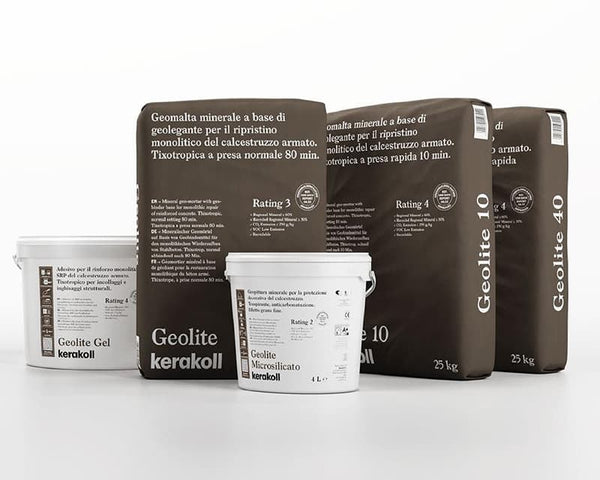
Substrates: Healthy, load-bearing reinforced concrete and concrete. Irregularities over 10 mm must be leveled first with Geolite geo-mortar; gaps wider than 0.5 mm must be sealed with Epofill injection.
Usage: Structural bonding of steel plates to coated concrete; anchoring rods into reinforced concrete elements; wet impregnation of Geosteel G steel fabrics in the certified Geosteel SRP reinforcement system; surface filling of cracks before Epofill injection.
Not suitable for: standalone reinforcement (the Geosteel G fabric alone is not a complete system); contaminated, greasy, dusty, or flaky surfaces; leveling large surface irregularities (use Geolite geo-mortar for that).
The Geosteel SRP reinforcement system
| 1. Substrate preparation |
healthy concrete + Geolite leveling — compact, rough, clean substrate |
| 2. Adhesive / matrix |
Geolite Gel — this product, first layer + fabric impregnation |
| 3. Reinforcement fabric |
Geosteel G600 / G1200 — galvanized steel fabric, the load-bearing element |
Mineral (SRG) or epoxy (SRP) matrix?
-
Mineral, breathable, fire-resistant (A1) matrix: Geolite geo-mortar + Geosteel G — the Geosteel SRG system
-
Epoxy, high-adhesion, wet impregnating matrix: Geolite Gel + Geosteel G — this product, the Geosteel SRP system
Frequently Asked Questions
What adhesive is used for steel fabric reinforcement on reinforced concrete?
A two-component, thixotropic epoxy adhesive that embeds the fabric and bonds it to the substrate. Geolite Gel impregnates the Geosteel G steel fabric in the certified Geosteel SRP system. It stays in place overhead and in heat, adhering to all substrates.
What is the difference between the Geosteel SRG and SRP systems?
Both use the same Geosteel G steel fabric but have different matrices. The SRG uses a mineral geo-mortar matrix (Geolite) — breathable, fire-resistant. The SRP uses an epoxy matrix (Geolite Gel) — high-adhesion, wet impregnating. The designer chooses based on the structure and environment.
Is Geolite Gel available separately?
Yes, it can be purchased separately — if you already have the Geosteel G fabric and prepared substrate, or if you need it for rod and plate anchoring. However, by itself, it is not reinforcement: the load-bearing capacity comes from the fabric. It can be used independently for anchoring and bonding.
What is thixotropic epoxy, and why is it good?
Thixotropic epoxy does not flow: it stays in place on vertical surfaces and overhead. Thus, Geolite Gel can be applied on ceilings and beams without dripping. It is also easy to work with at high temperatures, which is an advantage in hot summer conditions.
What does a high Tg mean?
Tg is the glass transition temperature — the temperature above which the epoxy softens. A high Tg means that Geolite Gel remains solid and load-bearing even in heat. This is an important safety factor in structural reinforcement.
Is substrate preparation necessary under the epoxy adhesive?
Yes — a clean, solid, roughened surface is required. Level out irregularities greater than 10 mm first with Geolite geo-mortar, and seal gaps wider than 0.5 mm with Epofill injection. Remove grease, dust, and dirt.
When should I NOT use this adhesive?
Do not use Geosteel G without fabric as standalone reinforcement — it is not a complete system. It is also not suitable for leveling large surface irregularities (for that, use Geolite geo-mortar). Do not apply on contaminated, greasy, or crumbling surfaces.
Can I apply it myself?
No — structural reinforcement requires static design and certified execution: sizing the system, professional embedding of the fabric, and substrate preparation. Load-bearing capacity depends on it. We undertake the complete execution.