Need to seal a gap around a fire-rated door or window? In a fire, a poorly sealed gap gives flames a way through. This foam provides tested fire-resistant sealing. Apply by hand with the applicator tube. This is Kerakoll Hyper Foam Fire M.
- For fire-resistant joints: fire-resistance rating of 30–240 minutes (EN 1366-4), depending on the joint design — for fire-compartmentation joints
- Difficult to ignite: B1 (DIN 4102-1, German standard) — for static (non-moving) fire-resistant seals
- For fire-rated doors and windows: for installing and sealing fire-rated and fire-compartmentation doors and windows
- Thermal and acoustic insulation: thermal conductivity 30 mW/m K (EN 12667), sound insulation 62 dB (EN ISO 10140) — helps reduce thermal bridges
- Retains its shape: shrinkage < 1% — does not recede after filling
- Manual application, no gun required: with applicator tube, ≈ 34 l of foam from a 760 ml canister — for manual work
- Paintable, plasterable: can be cut after 90 minutes, fully cures in 24 hours (+22 °C, 50% humidity) — before painting or applying gypsum plaster
| Feature |
Value |
| Type |
PU foam; fire-resistant, self-expanding polyurethane foam for manual application |
| Composition |
Polyurethane; polymerizes on contact with moisture |
| Performance |
B1 (DIN 4102-1); 30–240 minutes fire resistance (EN 1366-4), depending on the joint; thermal conductivity 30 mW/m K |
| Material consumption |
Fill the cavity only halfway
≈ 34 l of foam per canister |
| Packaging |
760 ml canister |
| Storage |
12 months |
What is it suitable for?
Substrates: Cement, masonry, metal, plastic.
Function: Sealing and filling gaps and openings where fire resistance is required; installing fire-rated and fire-compartmentation doors and windows; static fire-resistant seals; reducing thermal bridges.
Can be applied over: Paint, gypsum or gypsum plaster, after full cure.
Areas: Indoors (only in well-ventilated areas) and outdoors.
Not suitable for:
- For fire-resistant sealing of gaps containing cables
- As an alternative to intumescent fire-retardant paint
- In enclosed or poorly ventilated spaces
- For polyethylene, polypropylene, glass, silicone, Teflon
Steps for fire-resistant filling
| Layer |
Product |
Role |
| Preparation |
Spray water onto the substrate |
More even expansion, better adhesion |
| Filling, in layers for gaps over 4 cm |
Hyper Foam Fire M — this product |
Fills the gap and provides fire resistance |
| Cleaning |
Hyper Foam Clean |
Removing fresh, uncured foam |
| Surface — only if needed |
Paint, gypsum or gypsum plaster |
After full cure |
Which sealant do you need? — Sealants
| Task |
Product |
Subcategory |
| Moving joint in floors, façades, traffic surfaces; paintable |
Tetra Seal |
Hybrid sealant |
| Bonding and sealing with one product; paintable |
Tetra Fix |
Hybrid sealant |
| Same thing, transparent: glass, shower, next to Microresina |
Tetra Fix Crystal |
Hybrid sealant |
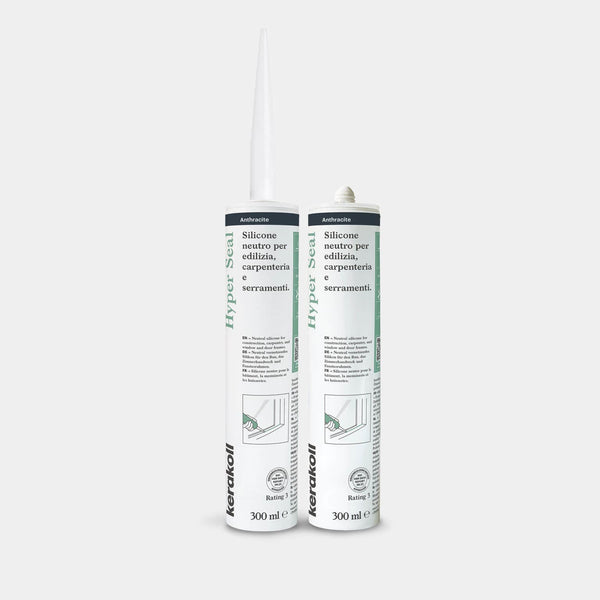
| Windows, doors, façade, glass; colored, not paintable |
Hyper Seal |
Silicone sealant |
| Same product, transparent |
Hyper Seal Crystal |
Silicone sealant |
| Cracks and joints before painting |
Hyper Fill |
Acrylic sealant |
| Filling gaps and fixing doors and windows by hand; dense, shape-retaining foam |
Hyper Foam M |
PU foam |
| Same product, applied with a foam gun or by hand; cures at low pressure and does not deform the frame |
Hyper Foam Combi |
PU foam |
| Firestop gap, applied by hand |
Hyper Foam Fire M — this product |
PU foam |
| Firestop gap, applied with a foam gun |
Hyper Foam Fire G |
PU foam |
| Bonding and repairing bituminous roofing membranes without a flame |
Bioscud BT Fix |
Bituminous sealant |
Hyper Foam Fire M or Hyper Foam Fire G?
|
Hyper Foam Fire M — this product |
Hyper Foam Fire G |
| Application |
By hand, with an applicator tube |
With a foam gun |
| Post-expansion |
< 150% |
< 50% |
| Yield |
≈ 34 l of foam / 760 ml |
≈ 51 l of foam / 750 ml |
Both products have the following in common: B1 (DIN 4102-1); 30–240 minutes of fire resistance (EN 1366-4), depending on the gap configuration; pink, self-expanding polyurethane foam; thermal conductivity 30 mW/m K; paintable and plasterable once cured; not suitable for gaps containing cables.
Frequently asked questions
What can be used to seal the gap around a fire door?
With fire-rated polyurethane foam, such as Hyper Foam Fire M. It is difficult to ignite (B1, DIN 4102-1, German standard) and provides 30–240 minutes of fire resistance (EN 1366-4). The rating depends on the gap configuration.
How many liters of foam does one canister yield?
≈ 34 liters from a 760 ml canister. Fill the cavity only halfway, as the foam continues to expand.
How long before it can be cut?
After 90 minutes at +22 °C and 50% humidity. Full curing takes 24 hours. It takes longer in cold, dry conditions.
Hyper Foam Fire M or Fire G?
For manual application with an applicator tube, use Fire M. For a foam gun, use Hyper Foam Fire G, which has less post-expansion. They have the same fire resistance ratings.
What does the fire resistance time depend on?
It depends on the width and depth of the gap; the test applies to a vertical, non-moving gap in a wall. A depth of at least 100 mm is required, or at least 200 mm for a rating over 90 minutes. The configuration must be coordinated with the fire protection plan.
Can it also be used for cable penetrations?
No: it cannot be used to firestop gaps containing cables.
How should a wide gap be filled?
Fill gaps wider or deeper than 4 cm in several layers. Spray water between layers and wait 20–30 minutes (+22 °C).
Can it be painted?
Yes, once fully cured; plaster or gypsum plaster can also be applied over it. It does not replace intumescent fire-retardant paint.
How can spilled foam be removed?
Clean with Hyper Foam Clean while fresh. Once cured, remove only mechanically.